


OVERVIEW
The trend of fast fashion has been increasing in Taiwan and caused not only the waste of clothes but also environmental issues.
Our team aimed to do user research on unnecessary consuming behavior beyond undergraduate and find out the solution. The goal is to make consumers aware of the waste of clothes caused by excessive consumption and get them to move on to change.
ROLE
Design Lead
User Research, Visaul Design, Media Promotion
OTHER INFORMATION
Organizer
Team Members
7 Members
Duration
3 months (Sept 2018-Dec 2018)
New Taipei City Computer Association

BACKGROUND
In recent years in Taiwan, influenced by the fast fashion trends blowing from Europe and the US, the traditional fashion industry has been subverting. Fast fashion focuses on shortening the production cycle, increasing the frequency of releasing new products, and constantly introducing new products. By removing cheap, neat, and beautiful styles of clothes, consumers are enticed to consume by their "wants" instead of "needs."
Under the temptation of fast fashion, college students often consume unnecessary clothes or buy clothes beyond their actual needs, resulting in a lack of money, wardrobe space, and other extended problems that affect their quality of life.
We saw the relevance of this issue to our daily lives, not just some distant part of the world. So we hope to shout out to the public to reduce unnecessary consumption and cherish clothing resources.
Picture Source: newhope.com
PROCESS
By following the double-diamond model, we are able to discover and define the problem, develop a solution, and deliver the solution into practical actions.

1
DISCOVER
Research Emphathy
LITERATURE RESEARCH
First of all, through a large number of news and literature search, we understand the issue of fast fashion, as well as the entire industry from front-end production to back-end consumer trading caused by waste.
Since the sense of identity is the deepest reason, and will extend to other problems. The project will only focus on the problem of consumer's surface reasons as the solution.
#1 Consumption behavior is interrelated with the context of consumers.
In other words, "what kind of people buy what kind of products". Paterson (2006) pointed out more precisely that "the goods purchased or used are a sign of social positioning, as a separation from other consumers".
#2 Consumer consideration is more related to social identity.
However, it is worth noting that the consumption behavior itself will also affect the self-concept of consumers, and thus affect the self-identity. Therefore, the behavior of consumption and the sense of identity are mutually shaping the dynamic process.
SCENARIO BRAINSTORMING
To understand users' experience, we immerse ourselves in the situation of consumers who go to a clothing store to buy clothes. By thinking our own experience and brainstorming the possible reasons why consumers decide to buy or not to buy. Eventually, we clustered three main reasons for not buying and six reasons for consuming clothes.

Originally in Chinese. To help understand, I translated it into English.


2
DEFINE
Finding Emphathy
After empathizing with the users, the big issue of fast fashion converges into 3 sub-issues:
#1 Overconsumption behavior.
#2 Clothing waste.
#3 Prolong the life of clothing.
As long as consumers buy extra clothes that they do not need, it is a kind of unnecessary consumption. We decided that excessive consumption should also be included in this topic.
Therefore, the topic is finally focused on the "unnecessary consumption behavior of consumers".
PERSONAS
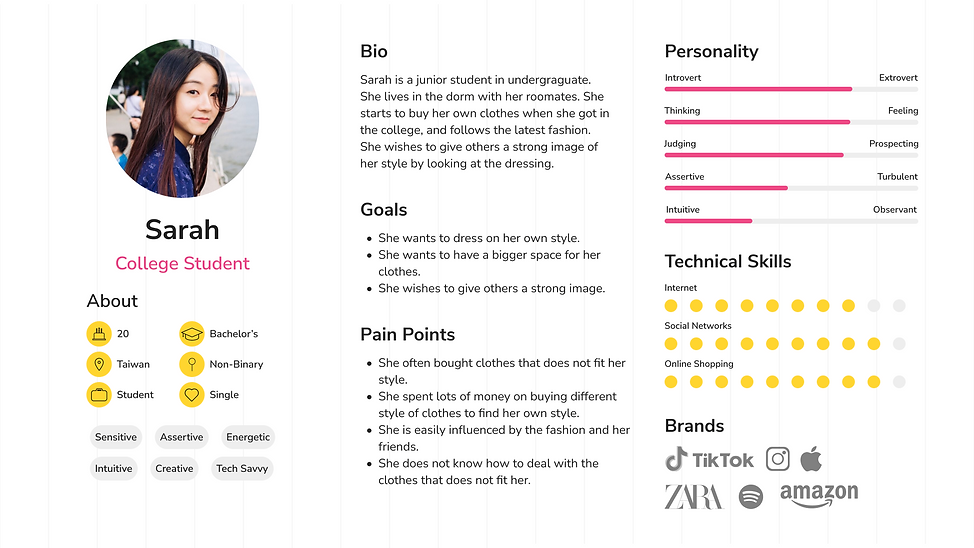
Based on the empathizing stage, we created an user persona to help us understand the user deeper. Our target users are college students in age of 18-22, and started to have financial controlled ability to buy for their own clothes. They can now decide the look of themselves and wish to show their own personality by dressing up themselves. After creating the perosonas, we can build up a solution better for the students.
JOURNEY MAP
Based on Sarah's persona that we created, we additionally built up a journey map that indicated Sarah's experience when going into a physical shop to shop for clothes.
Key takeaways:
#1 Consumers often does not think second time when paying.
#2 Consumers do impulse shopping, but mostly still based on the principle of easy to dress up.

3
DEVELOP
Digging in Ideation
Next, we come up with solutions to problems. We reignite ideas and build on other people's ideas to find multiple possible solutions. By using the situation below, we thinks of the possible solutions.
SITUATION
"A customer is standing in the shop ready to consume. However, there are tons of clothes in his house only wore once or never been worn. The staff and his friends keep telling him that he looks good in the clothes. He is now in the dilemma whether to buy or not to buy."
HOW-MIGHT-WE STATEMENT
→ "How do we keep buyers from spending too much money on unnecessary purchases?"
→ "How do we exempt the buyer from temptation?"
→ "How do we make rich people know how to dress instead of just buying clothes?"
→ "How can we get people who don't have enough closet space to reduce unnecessary spending?"
→ "How do we get people who are aware of waste to take action to reduce wasteful behavior?"
→ "How do we restore confidence to people who care too much about what others think?"
→ "How do we make people who can't find their own style find their own style?"
SOLUTION BRAINSTORMING
By using post-it to brainstorm for solutions, we clustered into three main solutions:
Considering the efficiency and time limit, we later decided to focus on #2 Create Fast-Fashion Consumer Befavior for Dummies online, and also flash events offline to promote the ideal.


#1 Hold Challenge Games
#2 Create Fast-Fashion Consumer Behavior for Dummies
#3 Hold Speeches with Opinion Leaders
4
DELIVER
Practical Actions

ONLINE ACTIVITY
Using Facebook's fan page to promote offline activity and increase the visibility of every post to share our idea.
Posts we shared in the fan page:
-
Fast-Fashion Consumer Befavior for Dummies: Giving out statistics for wasting the clothes and shouting out to consumers to think before buying.
-
Information of Offline Activities:
Sharing the information for flash events. -
Articles from Opinion Leaders:
Some good articles about fast-fashion's waste.
1370
Reach
58
Share
OFFLINE ACTIVITY
We went to the night market which mainly sells clothes to promote the idea of thinking before buying. By giving out little bookmarks that have tips to help consumers decide to buy the clothes or not. Later, we uses Google Sheet to collect feedback.
130
Reach
38
Reply of feedback


Context on the Bookmarks
Left:
"Do you still have money to spend in the end of the month?"
Right:
"We have come out with a solution!
Before buying, think of the THREE STEPS:
1. Do I need the clothes?
2. How often will I wear it?
3. Is the clothes durable?
From now on, the life of the clothes is decided by YOU."
KEY TAKEAWAYS
By following the double-diamond model, we are able to discover and define the problem, develop a solution, and deliver the solution into practical actions.
Some key takeaways are:
#1 Mix and Match: When promoting a idea, online and offline activities should be mixed and matched to best provide its efect.
#2 Double-Diamond Model is a tool: Those design thinking methods are tools for the team to help empathize and find out the painpoints of the users. It can be modified to best fit the team's need.
#3 Brainstorm is a good way: Whe doing design thinking, always brainstorm with the team to find out more ideas and possible thoughts. People may cover and build on each other's ideas to make it more complete.


